
What Can an Online Mass Spectrometer Tell You About Your Process?
What is actually in your chamber, while it is happening. A vacuum gauge gives you one number: total pressure. An online mass spectrometer breaks that number into its components, so instead of knowing that pressure is higher than it should be, you know it is water, or oil, or nitrogen leaking in through a fitting.
The four questions it answers
Is this a leak or is it outgassing? The most common vacuum question, and the most commonly guessed at. A real air leak shows nitrogen and oxygen in roughly atmospheric ratio. Outgassing shows water dominating, falling slowly as the chamber dries. The spectrum distinguishes them in seconds; pump-down curves alone rarely do.
Where is the leak? Spray helium around suspect joints and watch mass 4. The spectrometer sees helium arrive within moments of it reaching the leak, which turns leak hunting into a systematic procedure rather than a soap-bubble ritual.
Is my process gas what the bottle claims? Purity problems and cross-contamination from shared lines show up directly, which matters when trace contaminants change film properties.
What is happening during the process itself? This is where online analysis earns its name. In ALD or ALE, watching precursor and by-product signals cycle tells you whether the surface reaction actually saturated or whether you are wasting precursor and time.
Why the speed specification matters more than it looks
For static residual gas analysis, sampling speed is a convenience. For process monitoring it is the whole point. An ALD half-cycle can be a fraction of a second; a fast transient during a chamber event is shorter still. If the analyser needs longer to scan the mass range than the event lasts, you get an average of something interesting rather than a picture of it. This is why readout rates per amu, rather than the mass range alone, deserve attention when comparing instruments.
Dynamic range, and why two detectors exist
The gases you care about are frequently a millionth of the ones you do not. A Faraday cup is robust and linear for abundant species; a secondary electron multiplier provides the sensitivity for trace species. Instruments carrying both cover the range that real processes present, which is the practical reason dual-detector configurations are common on process tools.
A pressure gauge tells you something is wrong. A mass spectrometer tells you what.
Integration is what separates a laboratory instrument from a process instrument
An analyser that produces beautiful spectra on a laptop next to the tool solves half the problem. On a production system the data has to reach the tool controller, trigger alarms and be logged alongside process parameters. That is why industrial protocol support such as EtherCAT and Modbus, and an integrated pumping system that does not demand its own bench, matter as much as the analytical specification.
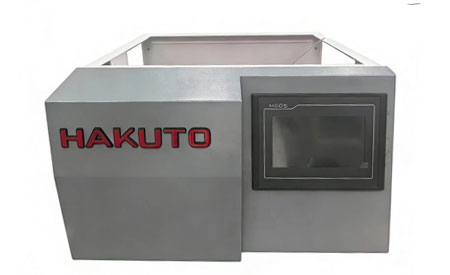
The Hakuto Genius online mass spectrometer we represent is built for that role: quadrupole analysis to 300 amu, up to 1000 readings per second per amu, Faraday and SEM detectors, EtherCAT and Modbus, with an integrated turbomolecular pump. To discuss your process, write to info@rexerlab.com.