When Should You Use Ion Beam Etching Instead of Plasma Etching?
When chemistry will not cooperate. Reactive plasma etching works by forming volatile compounds that pump away; if a material has no convenient volatile compound, the process stalls or leaves residue. Ion beam etching sidesteps the problem entirely by removing material physically, with accelerated ions knocking atoms off the surface.
The materials that force the decision
Magnetic materials. Permalloy, cobalt alloys and the multilayer stacks used in spintronics have no clean reactive chemistry. This is the classic case for ion milling, and it is why the technique is standard in magnetic head and MRAM work.
Precious and noble metals. Gold and platinum do not form volatile halides under normal conditions. Physical removal is the practical route.
Alloys and multilayers. A stack of different materials would need a different plasma chemistry per layer. A physical process treats them as one, which means one recipe rather than a sequence of them.
Some oxides and dielectrics. Hard-to-etch dielectrics that resist fluorine chemistry can be milled physically.
What you gain
Beyond material independence, there are three practical advantages. The process gas is argon alone, so no toxic gas infrastructure, abatement or associated permits are required. Directionality is excellent because the ions arrive collimated, which gives steep sidewalls. And because the mechanism is momentum transfer rather than chemistry, the etch rate is predictable from material density and beam parameters rather than from a chemistry that shifts with loading.
What you give up, honestly
Ion beam etching is not free of trade-offs, and any supplier who says otherwise is selling rather than advising.
- Selectivity is low. Physical sputtering removes the mask nearly as readily as the film, so mask strategy matters more than in a chemical process.
- Redeposition. Sputtered material can land back on sidewalls. Stage tilt and rotation manage it, but it has to be managed.
- Heat. The energy goes into the substrate. Sample cooling is not an accessory; for temperature-sensitive stacks it is the whole ballgame.
- Throughput. Physical removal is generally slower than an optimised reactive process on a material where chemistry works.
Use chemistry where chemistry works. Use ions where it does not.
Uniformity is the specification that decides quality
The practical quality metric for ion milling is how evenly the beam removes material across the substrate. Fixed-stage systems struggle; planetary motion, where substrates both orbit and rotate under the beam, averages out the beam profile and is what makes the numbers acceptable across a full wafer. When comparing systems, ask for uniformity figures on your substrate size rather than in the abstract.
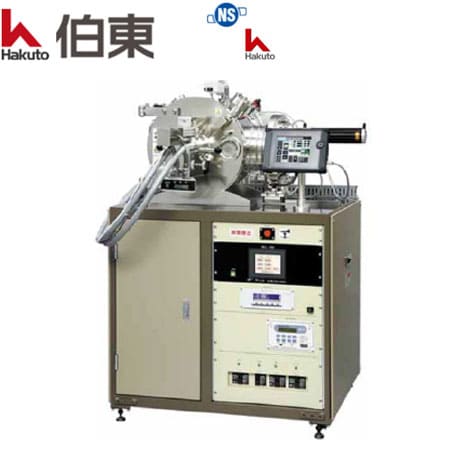
The Hakuto ion beam etching systems we represent use Kaufman sources from 8 to 20 cm with planetary stage motion, argon only, in configurations from a research tool through to large-scale production. If you want to discuss whether your stack is a candidate, write to info@rexerlab.com.