Ultrasonic Spray Coating or Spin Coating: Which Fits Your Thin Film?
Spin coating is simpler and hard to beat on a small flat substrate. Ultrasonic spray coating wins on material efficiency, coating area, textured or porous surfaces, and the path to production. Most laboratories that switch do so for one of those four reasons rather than for film quality alone.
Material waste is usually the first argument
Spin coating discards most of what you dispense; the great majority of the solution is flung off the substrate. With a routine solvent that is an annoyance. With a custom-synthesised polymer, a catalyst ink loaded with platinum, or a perovskite precursor made over three days, it is the dominant cost of the experiment. Ultrasonic spray deposits a much larger fraction of what is pumped, because the mist is directed at the substrate rather than thrown outward.
Where spin coating simply stops working
- Large substrates. Spin coating uniformity degrades as radius grows, and the mechanics become awkward. Spray systems scale by moving the nozzle over a larger area.
- Non-flat and porous surfaces. Gas diffusion layers, membranes, textiles and structured devices cannot be spun usefully. A low-velocity mist follows the surface.
- Non-circular geometry. Spin coating assumes rotational symmetry. Rectangular cells and irregular parts do not have it.
- Multilayer and graded films. Multi-channel spray systems can vary composition between or during passes.
What ultrasonic atomization actually contributes
The word ultrasonic is doing real work here. In conventional pressure spraying, the liquid is atomised by forcing it through a nozzle at high velocity, which produces a broad droplet size distribution and enough momentum to disturb delicate surfaces. Ultrasonic nozzles vibrate the liquid until it breaks into droplets, so droplet size is set by frequency rather than by pressure, the distribution is narrow, and the mist leaves the nozzle slowly. A separate low-pressure air shaper then guides the mist onto the substrate. Narrow droplet distribution is what makes the film uniform; low velocity is what lets you coat something fragile.
Spin coating optimises one sample. Spray coating optimises a process you intend to repeat.
The honest trade-offs
Spray coating has more parameters: flow rate, nozzle height, scan speed, path spacing, substrate temperature, air shaper pressure. That is more control, and also more to establish before you get a reproducible film. Expect a development period that spin coating does not require. Very thin films, in the low tens of nanometres, are also more demanding by spray, and solvent selection interacts with drying behaviour more strongly.
Choosing between systems
Once you have decided on spray, the practical questions are working area, whether the Z axis is automated or manual, how hot the substrate plate gets, and how many liquid channels you need. Substrate temperature deserves particular attention: for many materials the drying dynamics on the hot plate determine morphology, and a plate that reaches 200 °C serves a different set of chemistries than one reaching 500 °C.
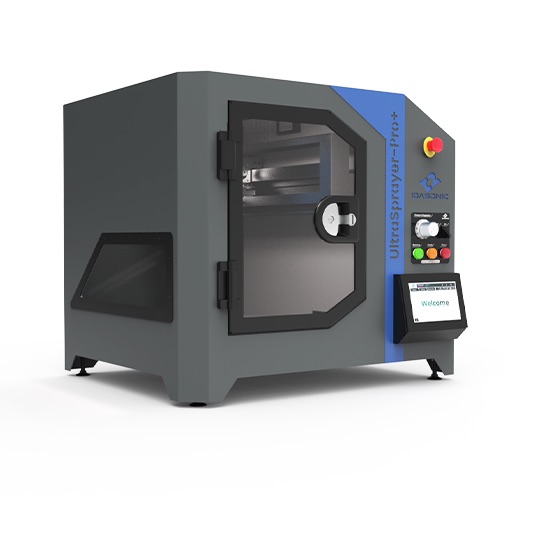
We represent both ends of the Idasonic range: the automated UltraSprayer-Pro for pilot-scale work and the desktop UltraSprayer-Essential for laboratories starting out. To talk through your material, write to info@rexerlab.com.